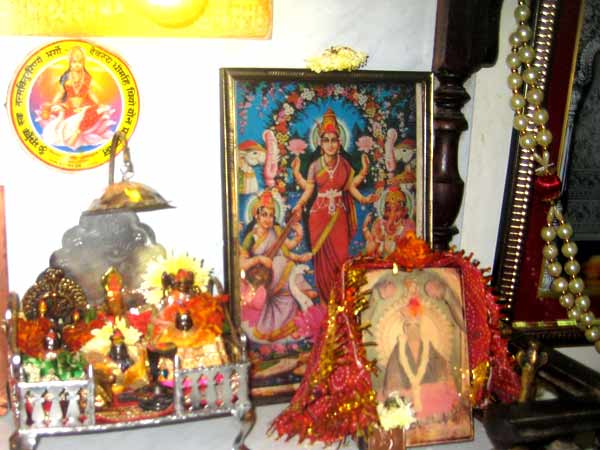
Lakshmi Puja forms an important ritual conducted
on Diwali. If you want to know the steps of Lakshmi Pooja, then go
through the article.
Lakshmi Pooja
|
Diwali is one of the most popular and liked Indian
festival. This beautiful festival of light is celebrated by all the
Indians around the globe. Lakshmi Pooja is one of the most important
features of Diwali celebrations. Lakshmi, who is considered the goddess
of light, beauty, good fortune and wealth, is worshipped on the occasion
of Diwali to bring prosperity in the family. She is also worshiped to
achieve success and fortune. It is however said that she does not reside
long with anyone who is lazy and untidy or desire her only as wealth.
That is why before the Lakshmi Pooja, people actively clean their home
and worship her with immense devotion.
Lakshmi is said to be the daughter of the sage Bhrigu. Legends say that
she took refuge in the ocean of milk when the gods were sent into exile.
Lakshmi was reborn when Lord and Demon churned the ocean to get ‘Amrut’,
the drink of immortality. However as the God had a glimpse of Lakshmi,
they all fell in love with her mesmerizing exquisiteness. First of all,
Shiva claimed Lakshmi as his wife, but as he had been given the Moon,
Lakhsmi’s marriage was performed with Vishnu, who was also a
preferred choice by the Goddess.
Steps of Lakshmi Pooja
Lakshmi Pooja is done in a very specific manner. First of all the
entire place for the pooja is cleaned and a higher platform with a new
cloth over at it is made realy for deity’s establishment. A kalash
(pitcher) made of gold, silver, copper, or terracotta is then placed
over it with handful of grains at the base. Three-fouth of the kalash is
then filled with water and a betel nut, a flower, a coin, and some rice
is placed in it. The Kalash is then decorated with mango leaves and
covered with a plate containing rice grains. It is auspicious to draw a
lotus with turmeric powder (haldi) over the rice grains and then place
the idol of goddess Lakshmi over it, along with coins.
Once the Goddess is established the Pooja is started in the presence of
entire family. At most of the places, Lord Ganesha is also worshipped
along with the Goddess. It is said that worshipping two of them together
is very auspicious and it brings wisdom and wealth together. The idol of
Ganesha is placed infront of the kalash, on the right (South-West
direction). It is said that placing ink and books related to your
business or occupation on the platform in front of him will bring wisdom
and knowledge.
The Pooja begins in the presence of entire family by lighting a lamp or
diya. The deities are offered haldi, kumkum, and flowers to the platform
on which the kalash is placed. Then Goddess Lakshmi is invoked by
reciting the Vedic mantras addressed to her. It is said that even if you
do not remember mantras you can also invoke the Goddess by simply
closing your eyes and remembering her with full devotion. Like other god
and goddesses, you can also offer her flowers and bathe her in
panchamrit, a mixture of milk, curd, ghee or clarified butter, honey,
and sugar). It is considered auspicious if Goddess Lakshmi is offered
some gold ornament or a pearl.
If you want to do an extensive pooja you can offer sandal paste,
saffron paste, perfume ( itr ), haldi, kumkum, abeer, and gulal to the
goddess along with a garland of cotton beads. Flowers specially marigold
and leaves of Bel, wood apple is also considered to be the favorite of
Goddess Laksmi. Along with earthen lamps, you can also light an incense
stick, dhoop and perform an elaborate havan. At the end, the aarti for
goddess Lakshmi should be performed.



