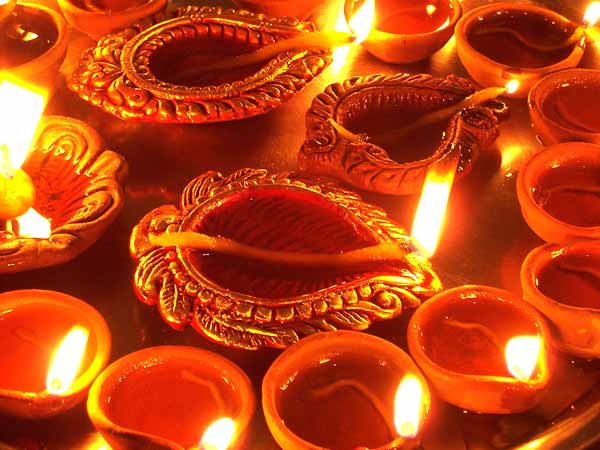
The festival of Diwali is celebrated with pomp
and gaiety all over India. Learn all about the celebrations of
Deepavali, in this article.
The festival of Diwali is celebrated by the Indians
throughout the world with special enthusiasm and zeal. May be this is
why, it is the most popular as well as liked festival in the country as
well as abroad. This festival of lights brings along with itself immense
enthusiasm and pleasure. Unlike other Indian festivals, the Diwali
celebrations are not limited to just one-day but it brings a series of
festivals and holidays with itself. As Diwali is the festival of Goddess
Lakshmi,the goddess of wealth, it is celebrated with great pomp and
show. Lights, crackers, sweets and abundant shopping are the most
awaited features of the Diwali season. Diwali is the festival, which
means celebration one after another, each day with a new philosophy.
Given here is a list of events that Diwali brings along with itself.
Diwali Celebrations in India
First Day - Dhanteras
Diwali begins with Dhanvantari Trayodashi (Dhanwantari Trayodashi),
which is the thirteenth lunar day of Krishna Paksha, of the Hindu month
of Kartik. Dhanvantari Trayodashi is popularly known as Dhan-teras.
Legends have it that Lord Dhanwantari (Lord Dhanwantari) came out of the
ocean with Ayurvedic on this day for the welfare of the mankind. The
people worship Lord Yamaraj, the God of death, on this day and light a
'Yama-Diya' in the night to offer prayers to Him. Purchasing a new
utensil by the people on this day is also a tradition related with
Dhanvantari Trayodashi.
Second Day - Choti
Diwali
After the Dhanvantari Trayodashi the second day of Diwali is Narak
Chaturdashi. Legends have it that Lord Krishna killed the demon
Narakasur on this day to make the mankind free from his fear. It is a
tradition to massage the body with oil and to bathe on this day.
According to an interesting saying it is believed that those who do not
bathe on this day go to the Narak (hell).
Third Day - Badi Diwali or
Lakshmi Puja
The third day of DIWALI also called Badi Diwali is the main day of
celebrations of the festival of Diwali. People perform Lakshmi Pujan
(worship of divine Goddess Lakshmi) on this day and offer prayers to her
to bless them with wealth and prosperity. On this day people clean their
homes and decorate it with various colorful lights and fire crackers to
express their joy.
Fourth Day - Govardhan
Puja (Gowardhan Puja) or Padwa
As the name itself suggests the fourth day of diwali is devoted to
Govardhan Pooja (worship of Lord Govardhan Parvat). Legends have it that
Lord Shri Krishna once performed the Govardhan Pooja along with the
people of Vraja for their protection from heavy rains. Since then it
became a tradition for Hindus to worship Govardhan Parvat to honour that
first Pooja on this day.
Fifth Day - Bhai Duj
(Bhaiya Dooj) or Bhratri Dooj
The fifth day of the diwali is Bhai Dooj, the time to honour the
brother-sister relationship. Legends have it that in the Vedic era, Lord
Yamaraj (the God of death) visited his sister Yamuna on this day and
blessed her with a boon that if brothers visit their sisters on this day
then they will be liberated from all their sins. Since then it is a
tradition that brothers visit their sisters on this day and the sisters
sweeten their mouths with variety of sweets. In the Bengali culture this
day is celebrated as 'Bhai Fota'. The celebration of the Bhai Dooj marks
the end of the five days long festivities of Diwali.