Navratri, a nine-day festival dedicated to Goddess Durga, has many stories as a part of its history. Read more to know about the origin of Navratri.
History of Navratri
|
Navratri is a very important Hindu festival celebrated in India, which is devoted to Goddess Durga. The festival is celebrated with great reverence and faith across the country. It stretches over a period of nine days, with each of the nine days being dedicated to one of the nine forms of the Goddess. Talking about the history of Navratri festival, it can be explained through the stories mentioned in the Hindu scriptures. In case you want to know more about them, explore the information given below
History & Origin Of Navratri
In different parts of India, different legends describe the history of Navratri:
North India
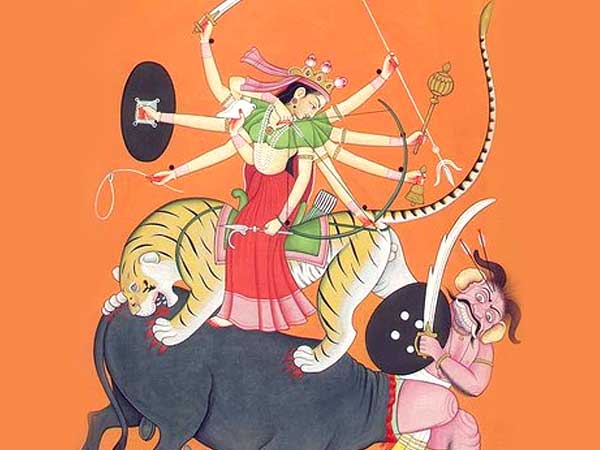
The legend in North India goes that Mahishasura, the mighty demon, worshipped Lord Shiva and obtained the power of eternity. Soon, he started killing and harassing innocent people and set out to win all the three lokas. The gods in swargaloka appealed to Lord Shiva, to find a way to get rid of the demon. To protect the world from the atrocities of Mahishasura, the Trinity of Brahma, Vishnu and Shiva united their powers and created a divine female warrior, known as Goddess Durga. Mahishasura, when he saw the divine beauty of Goddess Durga, got mesmerized.
So fascinated was Mahishasura by Goddess Durga's beauty that he approached her with the intention of marriage. The goddess agreed to marry him, but put forth a condition - Mahishasura would have to win over her in a battle. Mahishasura, proud as he was, agreed immediately! The battle continued for 9 nights and at the end of the ninth night, Goddess Durga beheaded Mahishasura. The nine nights came to be known as Navratri, while the tenth day was called Vijayadashmi, the tenth day that brought the triumph of good over evil.
Eastern Belief
As per the legend prevalent in East India, Daksha, the king of the Himalayas, had a beautiful and virtuous daughter called Uma. She wished to marry Lord Shiva, since her childhood. In order to win over the Lord, she worshipped him and managed to please him as well. When Shiva finally came to marry her, the tiger-skin clad groom displeased Daksha and he broke off all the relationships with his daughter and son-in-law. One fine day, Daksha organized a yagna, but did not invite Lord Shiva for the same.
Uma got so angry at her father's rude behavior, towards her husband, that she decided to end her life by jumping into the agnikund of the yagna, where she was united with eternity (since then, she came to be known as Sati). However, she took re-birth and again won Shiva as her groom and peace was restored. It is believed that since then, Uma comes every year with Ganesh, Kartik, Saraswati and Laxmi and two of her best friends or 'sakhis', called Jaya and Bijaya, to visit her parent's home during Navratri.
Another Legend - Ram and Ravana
Yet another legend of Navratri relates to the Hindu epic Ramayana. It goes that Lord Rama worshipped Goddess Durga in nine aspects, for nine days, in order to gather the strength and power to kill Ravana. He wanted to release Sita from the clutches of powerful demon king Ravana, who had abducted her. Those nine nights became to be known as Navratri and the tenth day, on which Lord Rama killed Ravana, came to be called Vijayadashmi or Dusshera, signifying Rama's (good) triumph over Ravana (evil).



