Navratri is celebrated in almost every region of India, though with a little difference. Read the article to know more about Navratri celebrations.
Navaratri Celebrations
|
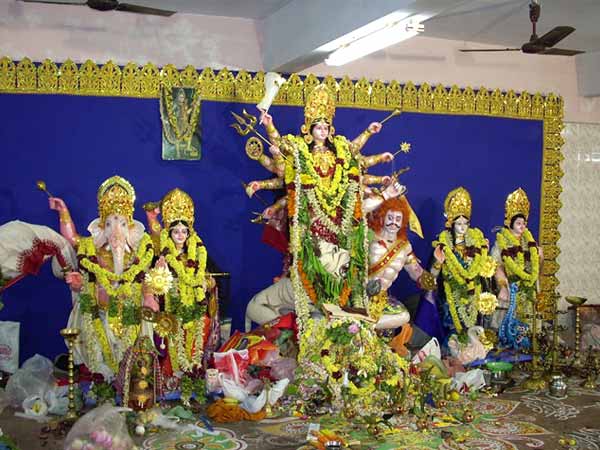
The nine days and nights of Navratri are dedicated to Mother Goddess. The celebrations of the festival include fasts, strictly vegetarian diet, japa (chanting mantras in honor of the Goddess Shakti) and recitation of religious hymns, prayer, meditation and sacred texts related to Goddess Durga. Navratri is celebrated twice a year - once in the month of Chaitra (April-May) and again in the month of Ashwin (September-October). On both the occasions, nine different forms of Goddess Durga are worshipped. In the September-October celebrations, the main ritual consists of placing images of the Goddess in homes and temples. On the tenth day, the idol is immersed in water. Numerous other celebrations are also associated with Navratri festival. Let us know more about the celebrations of Navratri.
Navaratri Celebrations
Bengal
During Navratri, Bengalis in India worship huge idols of the Goddess, perform devotional songs and dances and finally take out grand processions on the tenth day, when the idols are immersed in water. The last four days of the festival are most important for them. People worship pre-pubescent young girls, known as 'kanyas', as the embodiments of Goddess Durga. 'Ayudha Puja' is performed on the ninth day, where one worships the tools, implements of their livelihood and places it on the altar of the Goddess for her blessings of success and prosperity. Even children place their study books and writing tools on the altar and the families spend whole day in contemplation of the Goddess. On the tenth day of Dussehra, devotees perform 'Saraswati Puja' for blessings of knowledge and mental peace. During Navratri, thousands of devotees visit Dakshineswar Kali Temple in Kolkota, West Bengal.
Gujarat
In Gujarat, Navratri is a community event, where people perform devotional songs and dances that are popular by the names of 'Dandiya Raas' and 'Garba Raas', and observe Jaagran (waking through the night), to please the Goddess. Amba Mata Temple at Junagarh, Gujarat, is a favorite pilgrim for devotees, during Navratri. Here, painted earthen pots are used to represent the Goddess and Garba dances are performed by the Gujarati women around those pots, in circles. The pots are valued as the abode of the Goddess. The Rasa has its origin in the life scenes of Lord Krishna and is associated with the agricultural rites, while Garba is performed only by men and is related with the agricultural fertility.
Maharashtra
In Maharashtra, Goddess Durga is worshipped continuously for nine days of Navratri. On the tenth day, Goddess Saraswati is worshipped and on this day, school-going children worship the tantrik symbol of the goddess for her blessing in their studies. This day is also considered auspicious to begin any new thing or to buy new ornaments. Puja is performed on each day of Navratri and devotees offer the flower garland to the idol or image of the goddess Durga. In Mumbai, people visit various temples including the Ayyappa Temple at Goregaon.
Kashmir
In Kashmir, Hindu minorities of Kashmiri Pandits celebrate Navratri. People generally observe fast for nine days and stay on water and fruits or eat the food specifically made for the fast, only in the evening. They usually visit the temple of their guardian goddess Kheer Bhawani, on all nine days of Navratri. Aarti is held on the last day of Navratri at the temple and it is only after which, people break their fast. Many devotees also go to the mountain cave of the Vaishno Devi Temple, during Navratri.
Kerala
In Kerala, there is a tradition of beginning of formal education for every child aged 3-5 years on the auspicious occasion of Durga Puja. On Ashtami, according to the custom, tools are not used and are worshiped on this day. Goddess Saraswati is honored by worshiping the books and records at home, on Navami. Thousands of devotees visit Saraswati temple at Kottayam, during Navratri, to take a dip in the mysterious holy pond. People also visit the famous temples at Thekkegram (Palghat).
Mysore, Tamil Nadu, Karnataka & Andhra Pradesh
In Mysore, Chamundi, the royal deity of the Mysore royalty is worshipped during Navratri, with pomp and pageantry. There is a magnificent procession of elephants, horses, chariots and costumed attendants on the tenth day, when Maharaja goes to worship the hilltop temple of the goddess. In Tamil Nadu, Karnataka and Andhra Pradesh, women arrange 'Bommai Kolu', a special placing of dolls decorated with flowers and ornaments on specially prepared steps. Nine young 'kanyas' or virgins are offered new clothes and sweets. The married women share flowers, kumkum and snacks among themselves. Thus, Navratri is celebrated in almost every region of India, with little difference.



