Karwa chauth is celebrated along with various customs and rituals. Read the article given below to know more about the customs of karva chauth.
Karwa Chauth Customs
|
Karwa Chauth is one of the most awaited festivals of North India, which is celebrated by the married women mainly. On this day, they keep a fast for the long life, well being and prosperity of their husband. Karwa chauth reflects joy, splendor, brightness and happiness of a married life. Thus, things that symbolize and reflect the marital status of a woman, such as jewelry, bangles, henna, bindi, and lehnga choli, are in high demand on this special occasion. The festival also brings people together and provides them an opportunity to socialize with friends and family members, exchange gifts and share home-cooked meals. Let us explore the customs of karva chauth in detail.
Karwa Chauth Rituals & Traditions
Sargi
The preparations for karva chauth start the day before the festival. Brides get beautifully wrapped baskets with the sargi (the food to be eaten before sunrise) from their mother-in-law. The fasting women of the neighborhood get together before sunrise, to eat the sargi, which mainly consists of thirst-quenching foods, like fruits, along with a main course of potatoes eaten with hot puris (a deep-fried Indian bread). Traditionally, a newly wed woman spends the day before the fast in her mother's house and comes to her mother-in-law's house only on the day of karwa chauth.
Baya
On karwa chauth, married women wear bright and beautiful clothes, heavy jewelry and bangles. They also get intricate patterns drawn, with henna, on their palms and feet. Traditionally, it is the mother who usually sends baya, which includes sweets, money, clothes and a karva (small earthen pitcher), to their married daughters' houses. In the evening, the mother-in-law or any elderly women of the house accepts the baya, given to them by the younger married women of the family. Thus, the festival of karva chauth involves not only the married women, but other members of the household as well.
Puja
The women of the neighborhood usually gather in someone's house and perform the puja together, in the evening. A small area is prepared for the ceremony, which can be performed in any part of the house as well as in the open. A small square platform is placed against the wall and kharia matti (powdery mud) is used to cleanse and to decorate the puja area. An idol of Gaur Mata, or Goddess Parvati (the consort of Lord Shiva), is placed on the consecrated spot. Traditionally, the tiny image of Gaur Mata was made from cow dung, though nowadays pictures or idols of Parvati are the norm.
Story
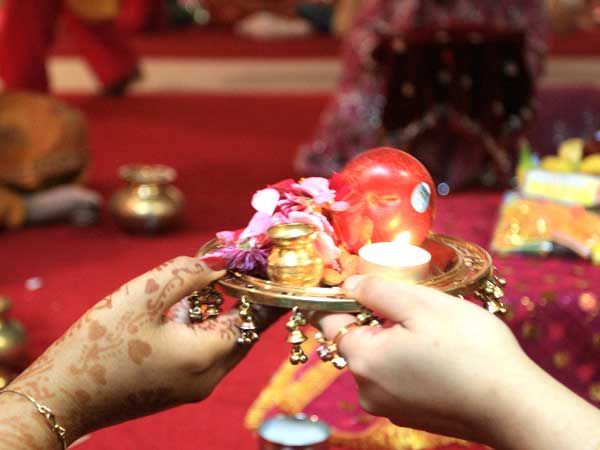
About an hour before moonrise, the women place their bayas and their karvas in a plate and sit around the puja area to pray, while an elderly lady narrates a tale about a young woman who, by an unfortunate twist of fate, was tricked into breaking her fast before moonrise. Her husband dropped dead the very instant his wife broke her fast. Enraged at the deception that led to her husband's death, the girl implored Gaur Mata to resurrect her husband.
The husband finally came back to life after a period of seven karva chauths. The wife, with her unflinching love for her husband and belief in Goddess Parvati, achieved the 'impossible'. While the story is read out to everyone, the women exchange their respective karvas, till each one gets her own karva back. During this time, they also chant the following prayer ,which is for the well being of the husband and for marital bliss:
"Addey-addey Krishna pakshe var
Tith Karva Chauth
Manse hain apne suhag ke liye
Yeh karva, mattri, halwa, sari, nagdi
Apne suhag ka liye rani ka sa raj dena
Gaur ka sa suhag dena Shri Krishna nimant."
The puja ends with the women showering rice and vermilion on Parvati and seeking her blessings. The younger women touch the feet of the elders, seek their blessings and offer their baya to them.
Breaking The Fast
In the evening, the women see the moon, while carrying a plate decorated with lit earthen lamps and a container of water. The moon is seen through a fine mesh or sieve. Water is offered to the moon, followed by some food women. Though the women are allowed to break their fast after they see the moon, it is preferred if they can also see the faces of their husbands before they eat or drink. So, the married men scurry back home from work as soon as possible, on this day. Thereafter, the family sits down for a grand meal and the celebration comes to end.



